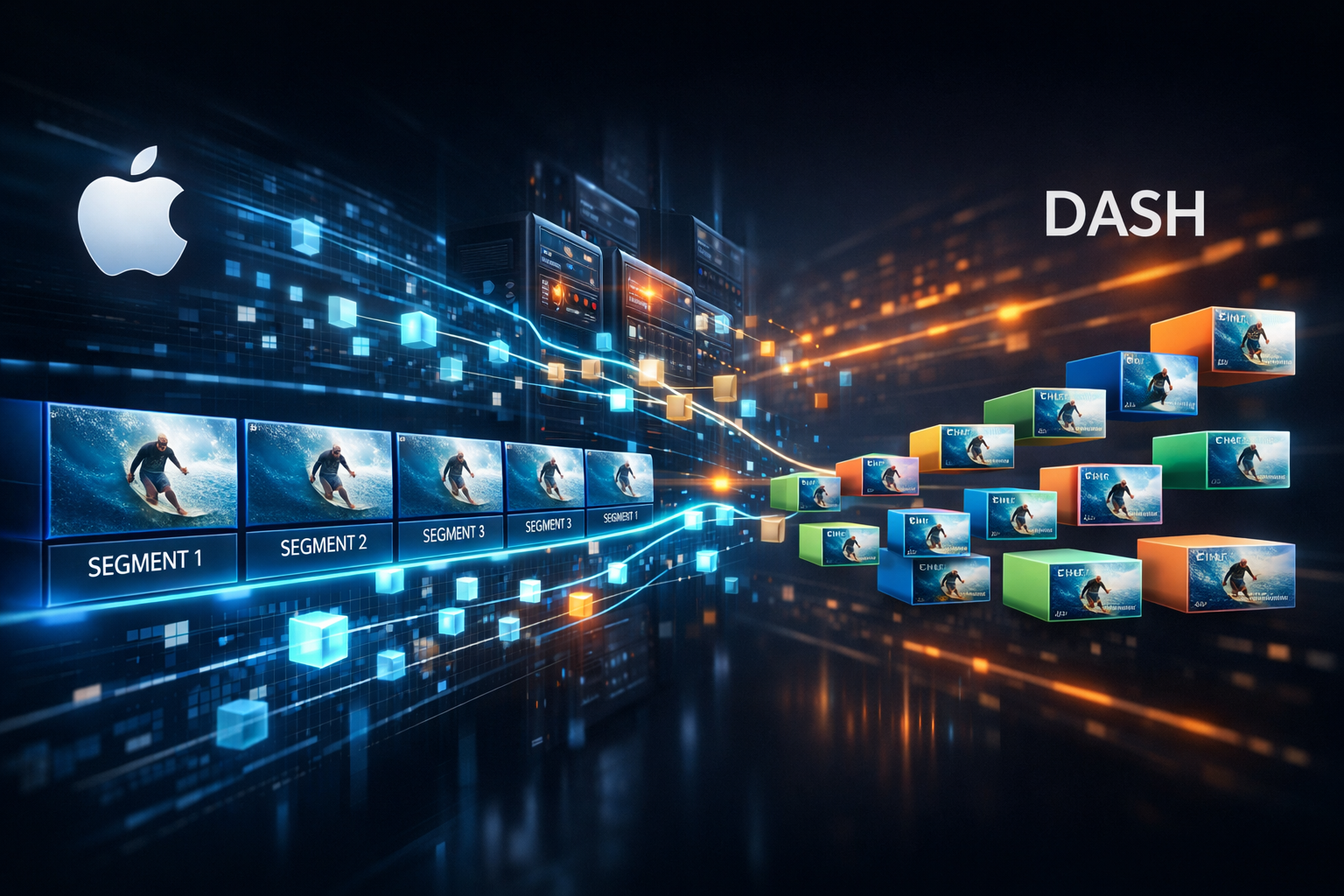
HLS vs DASH: Choosing the Best HTTP Video Delivery Protocol for Live Streamers
If you’re a radio DJ who also does live video, a church broadcaster, a school station, or a podcaster adding visual simulcast, you’ve probably heard: “Use HLS” or “Use MPEG-DASH.” Both are HTTP-based adaptive bitrate (ABR) streaming protocols that deliver segmented media over regular web infrastructure (origins, CDNs, caches), making them far easier to scale than legacy “one socket per listener” streaming.
This module compares HLS vs DASH using broadcaster priorities: latency, device reach, player simplicity, DRM, costs, and workflow complexity. We’ll also map the practical decision to real-world constraints like iOS Safari, smart TVs, CDNs, and how you can keep a flat predictable bill instead of surprise per-hour/per-viewer charges.
If you mainly stream audio today (SHOUTcast/Icecast) and want video add-ons, the key mindset shift is: ABR video is about multi-bitrate ladder + segmentation + manifests. Once you understand that, HLS and DASH become two dialects of the same “HTTP video” concept.
Pro Tip
If your business depends on predictable monthly costs, avoid platforms with expensive per-hour/per-viewer billing (a common complaint with Wowza-style pricing). With Shoutcast hosting at Shoutcast Net you get a flat-rate unlimited model (starting at $4/month), 99.9% uptime, SSL streaming, and unlimited listeners—ideal when your audience spikes for events.
HLS vs DASH at a Glance (what matters for broadcasters)
What HLS is (in one practical definition)
HLS (HTTP Live Streaming) is Apple’s ABR protocol. It packages content into small media segments (historically MPEG-TS, increasingly fMP4/CMAF) and uses an M3U8 playlist manifest. HLS is the default answer for “will it play on iPhones and iPads?” because iOS Safari has native HLS support.
What DASH is (in one practical definition)
MPEG-DASH is an open standard ABR protocol. It typically uses fMP4 segments and an MPD (XML) manifest. DASH is common in Android/TV ecosystems, modern web players using MSE, and enterprise DRM workflows.
Broadcaster decision lens
- Device reach: HLS wins for native iOS Safari. DASH wins for standards-based DRM and some OTT stacks.
- Latency: Both can be low-latency when paired with CMAF chunking and low-latency modes (LL-HLS, DASH-LL), but implementation maturity differs by player/device.
- Operational simplicity: HLS is often simpler to “just work” across a broad range of consumer devices; DASH can be cleaner in controlled apps with DRM.
- Cost predictability: The protocol doesn’t set your bill—your hosting model does. Prefer providers that don’t meter you into surprise charges when you “Restream to Facebook, Twitch, YouTube”.
For audio-first creators (DJs/podcasters), a common hybrid approach is: keep your primary audio stream on SHOUTcast or Icecast, then run video ABR for simulcasts and events. Shoutcast Net helps you stream from any device to any device and bridge any stream protocols to any stream protocols (RTMP, RTSP, WebRTC, SRT, etc) depending on your workflow.
Pro Tip
If you’re moving from “legacy SHOUTcast-only thinking” (single bitrate, one format) to video ABR, plan your bitrate ladder first. ABR is what prevents buffering for mobile listeners on weak networks. For audio stations, pair your live shows with AutoDJ so your stream stays online even when your encoder disconnects.
Comparison Table: latency, compatibility, DRM, costs
The table below focuses on real broadcaster constraints: “Will it play everywhere?”, “Can I do DRM if I need it?”, “How low can I go on latency?”, and “What does it cost me to scale?” Costs here describe typical industry billing patterns—your actual costs depend on whether you choose flat-rate unlimited hosting or per-usage metering.
| Protocol / Mode | Typical Latency | Device / Browser Compatibility | DRM Story | Operational Notes | Cost Risk (common market models) |
|---|---|---|---|---|---|
| HLS (classic TS) | 10–30s (often higher if conservative segment sizes) | Excellent on iOS/iPadOS Safari; good elsewhere via players | FairPlay (Apple) in supported stacks; AES-128 also used | Easy distribution via CDN; TS is heavier than CMAF | Low protocol risk; billing depends on provider (avoid per-viewer surprises) |
| HLS (CMAF fMP4) | 6–15s (and lower with tuning) | Strong across modern devices; iOS support is solid | FairPlay + Common Encryption workflows vary by platform | Better efficiency; aligns with low-latency chunking concepts | Often paired with “premium” packaging on metered vendors |
| LL-HLS (Low-Latency HLS) | very low latency 3 sec to ~6s in well-tuned systems | Best on Apple ecosystem; requires compatible players/CDN behavior | FairPlay possible; complexity rises | Uses partial segments, preload hints, blocking reload | Higher origin/CDN request rates; metered providers can charge more |
| MPEG-DASH (standard) | 6–20s | Great in apps/OTT; web via MSE; not native in iOS Safari | Best-in-class standardized DRM (Widevine/PlayReady) via CENC | Strong for controlled environments; manifest is MPD (XML) | Packaging/DRM stacks often bundled into higher-cost plans |
| DASH-LL (Low-Latency DASH) | ~2–6s (depends on player/device/CDN) | Excellent in modern MSE players; device variability remains | Same CENC advantages as DASH | Uses chunked transfer and CMAF chunks | Can drive more requests; per-request/per-GB pricing can grow fast |
| WebRTC (ultra-low latency) | 0.2–1.5s (interactive) | Great on modern browsers; not CDN-cache friendly | Different security model (DTLS-SRTP), not typical DRM | Best for calls, auctions, live interaction; scaling needs SFU/MCU | Compute-heavy; vendors often bill per-minute/per-participant |
Notice that HLS and DASH are both “HTTP ABR.” The biggest practical differentiator for many broadcasters is iOS Safari (HLS) vs standardized DRM and controlled apps (DASH). For most public, ad-supported, open streams, HLS is the path of least resistance—especially if your audience includes iPhones in the car or at events.
Pro Tip
When comparing vendors, separate protocol capability from billing model. Many “video platform” stacks (including legacy Wowza-style ecosystems) attach low-latency + packaging + DRM to expensive per-hour/per-viewer billing. Shoutcast Net emphasizes a flat-rate unlimited model for broadcasters who don’t want their bill to spike when a church service goes viral.
Latency Deep Dive: CMAF, LL-HLS, and DASH-LL
Why “segment size” creates latency
Traditional HLS and DASH deliver complete segments (often 2–6 seconds each). A player usually buffers multiple segments to avoid rebuffering. That means if you produce 6s segments and the player holds 3 segments, you’re already around 18 seconds behind live—before you account for encoder, network, and CDN.
CMAF: one media format, two manifests
CMAF (Common Media Application Format) standardizes fragmented MP4 (fMP4) segments so the same media chunks can be referenced by either HLS (M3U8) or DASH (MPD). That’s powerful because you can encode once and “publish” to both ecosystems with minimal repackaging.
# Conceptual view (same CMAF chunks, different manifests)
# Encoder outputs: video/audio fragments (fMP4)
# Packager writes:
#   - HLS playlist (.m3u8) pointing to fragments
#   - DASH manifest (.mpd) pointing to fragments
LL-HLS: partial segments + playlist hints
LL-HLS reduces latency by letting players request partial segments (often called parts) as they are produced, instead of waiting for the full segment to close. It also uses features such as blocking reload and preload hints so the player can stay “right on the edge” of live.
In well-tuned environments, LL-HLS can reach very low latency 3 sec while still using HTTP delivery that works through CDNs—meaning you can scale a large event without turning your origin into a bottleneck.
DASH-LL: chunked CMAF + MSE players
Low-Latency DASH uses CMAF chunking and can stream chunks via chunked transfer encoding so the player begins decoding before the segment is “complete.” In web environments, this often relies on robust MSE-based players. DASH-LL can be excellent in controlled deployments (apps, set-top boxes, kiosk players) where you control the playback stack.
Latency budget: where the seconds go
Even with LL modes, latency is an end-to-end budget. Here’s a simplified breakdown:
Camera/Mic
  ↓ (capture buffer: 50-200ms)
Encoder
  ↓ (GOP + lookahead: 0.5-2.0s)
Packager (CMAF)
  ↓ (part duration: 200-500ms)
Origin
  ↓ (CDN propagation: 100-800ms)
Player buffer
  ↓ (target latency: 2-6s)
Glass-to-glass latency
For music streamers and church broadcasters, the “right” latency depends on your use case: if you need chat interaction, aim lower; if you prioritize stability for long services, a slightly higher latency can be safer.
Pro Tip
Low latency increases request rates (more parts, more manifest refreshes). On metered platforms, that can translate into bigger bills. If you plan to Restream to Facebook, Twitch, YouTube plus run your own player, a flat-rate approach is safer. Start with a predictable plan and test during your 7 days trial to find the best latency/stability point.
Device Support & Players: iOS, Android, web, OTT
iOS / iPadOS: why HLS is still the default
On iPhones and iPads, Safari natively supports HLS. That means fewer moving parts: you can often play HLS without a heavy JavaScript player, and you get power-efficient decoding and system-level media handling. DASH is generally not natively supported in iOS Safari, so it requires workarounds (custom apps, different playback paths, or server-side choices).
Android: both can work, player choice matters
Android devices can play both HLS and DASH depending on the player. In native apps, ExoPlayer supports HLS and DASH. In browsers, HLS usually needs MSE-based playback (or falls back to native on some environments), while DASH commonly uses MSE plus a DASH-capable JS player.
Web playback: MSE-based players vs native HLS
On desktop web, neither protocol is universally “native” across all browsers in the same way iOS treats HLS. Many sites use JavaScript players that implement HLS and/or DASH over Media Source Extensions (MSE). Practically:
- HLS: native on iOS Safari; MSE-based on most desktops (common libraries exist).
- DASH: typically MSE-based; strong in environments designed around DRM and MPD.
OTT / Smart TVs: depends on platform and certification
OTT devices (Roku, Fire TV, Apple TV, Android TV, Tizen, webOS) vary widely. Some favor HLS, some favor DASH, and some support both through platform SDKs. For broadcasters, the easiest path is often “HLS for broad reach,” and “DASH when your OTT stack or DRM requirement demands it.”
What audio-first broadcasters should do
If you’re a DJ, school radio station, or podcaster, your listeners may never watch video—but they absolutely care that your stream loads fast and doesn’t buffer. Keeping an SSL streaming audio endpoint while adding video ABR for special events is a sane step-by-step rollout.
Shoutcast Net is designed to stream from any device to any device, and to bridge any stream protocols to any stream protocols (RTMP, RTSP, WebRTC, SRT, etc) so you can keep your proven audio pipeline while expanding into video when it makes sense.
Pro Tip
If your audience includes iPhone users, make HLS your “must-have” output. Add DASH when you have a specific reason (DRM standardization, certain OTT requirements, or a controlled app). If you’re not sure, start with HLS and validate performance during the 7 days trial.
Workflow Architecture: encoder → origin → CDN → player
The standard ABR pipeline
Whether you deliver HLS or DASH, the high-level workflow looks like this:
         Contribution (to your platform)          Distribution (to viewers)
┌───────────┐   RTMP/SRT/WebRTC   ┌──────────┐   HTTP (HLS/DASH)   ┌─────────┐
│ Encoder   │ ───────────────────►│ Origin / │ ───────────────────►│  CDN    │
│ (OBS, HW) │                     │ Packager │                     └────┬────┘
└─────┬─────┘                     └────┬─────┘                          │
      │   ABR ladder (1080/720/480...)  │  manifests + segments          │
      └─────────────────────────────────┘                          ┌─────▼─────┐
                                                                    │  Player   │
                                                                    │ (Web/App) │
                                                                    └───────────┘
Contribution protocols: how you feed the origin
Your camera/OBS does not “speak HLS” to the server. You usually contribute via RTMP (widely supported), or newer/stronger options like SRT. For ultra-low-latency interactive scenarios you might use WebRTC. The origin/packager then produces HLS/DASH for viewers.
This is why infrastructure flexibility matters: being able to accept one protocol and output another is how you build resilient workflows. Shoutcast Net focuses on bridging workflows so you can push from the field on whatever works and still deliver reliably to audiences.
Encoding ladder basics (ABR that actually helps)
ABR works when each rendition is meaningfully different. For a typical live event, a starting ladder might look like:
# Example ABR ladder (video)
1080p: 5.0 Mbps (H.264)  / audio 128 kbps AAC
720p : 2.5 Mbps (H.264)  / audio 128 kbps AAC
480p : 1.2 Mbps (H.264)  / audio 96 kbps AAC
360p : 0.7 Mbps (H.264)  / audio 64 kbps AAC
For music-heavy content (DJs, concerts, worship), don’t starve audio. Viewers will forgive softer video before they forgive crunchy sound.
Origin and CDN: why HTTP scales
HLS/DASH segments are just files over HTTP. CDNs cache them near users, reducing load on your origin. That’s why ABR over HTTP tends to survive “audience spikes” better than legacy streaming where every listener creates long-lived server connections.
This is also where provider billing differs dramatically. Some vendors charge by concurrent viewers, minutes, and packaging features (the classic “meter running” model). Shoutcast Net’s approach is built for broadcasters who want unlimited listeners and predictable plans rather than a surprise invoice after a big show.
Audio broadcasters: SHOUTcast + AutoDJ + events
If you’re primarily audio, you can still build a professional “always-on” station using SHOUTcast plus AutoDJ for continuity. When you add video events, you can keep the station online while you swap encoders, move venues, or reboot hardware.
Pro Tip
Don’t let “legacy SHOUTcast limitations” define your 2026 workflow. Keep SHOUTcast for what it’s great at (stable audio distribution), then layer modern delivery where needed. With Shoutcast Net you can start small (plans from $4/month), keep SSL streaming enabled, add AutoDJ, and scale without stepping into Wowza-like expensive per-hour/per-viewer billing. Browse options in the shop.
Best Picks by Use Case: DJs, podcasts, churches, IPTV
Radio DJs & music streamers (live video optional, audio must be bulletproof)
Best pick: HLS for video delivery, paired with SHOUTcast audio as your primary channel.
- Why: Your audience is mobile-heavy; iOS compatibility is critical.
- Latency target: 6–15s is usually fine for music shows; go LL-HLS if you need live chat syncing.
- Operational move: Keep an always-on station using AutoDJ so “dead air” never happens.
If you simulcast video, consider a workflow that also lets you Restream to Facebook, Twitch, YouTube while maintaining your own player feed.
Podcasters (live recordings, premieres, and listener call-ins)
Best pick: HLS for public live streams; consider WebRTC only for interactive segments.
- Why: HLS is straightforward for embedded web players and iOS viewers.
- Latency target: Standard HLS/DASH latency is often acceptable for premieres; use LL-HLS if you need tight Q&A timing.
- Cost control: Choose a flat-rate host so a successful episode doesn’t blow up your budget.
Church broadcasters (reliability, reach, and predictable scaling)
Best pick: HLS (CMAF if available), optionally with LL-HLS for interactive services.
- Why: Congregations include many iPhone users; “click and it plays” matters.
- Latency target: 6–20s for stability; very low latency 3 sec only if you truly need real-time interaction.
- Business requirement: When holiday services spike, you want unlimited listeners and no per-viewer penalties.
Shoutcast Net’s model is broadcaster-friendly: 99.9% uptime, SSL streaming, and predictable plans—avoiding the per-usage surprises that often come with Wowza-like “metered streaming stacks.”
School radio stations (simple operations, mixed devices, limited budget)
Best pick: HLS for campus events + SHOUTcast/Icecast for daily radio audio.
- Why: Easy playback across student devices; minimal tech overhead.
- Budget: Start at $4/month and scale as needed instead of per-minute billing.
- Continuity: Use AutoDJ so the station stays live between shows.
If you want an Icecast-style ecosystem for certain apps, Shoutcast Net also offers icecast hosting—choose what fits your players and community.
IPTV / OTT-style deployments (apps, DRM, controlled playback)
Best pick: DASH when your stack depends on standardized DRM (Widevine/PlayReady) and controlled apps; still keep HLS available for Apple-centric devices.
- Why: DASH integrates cleanly with CENC DRM pipelines and managed device ecosystems.
- Playback reality: You may end up delivering both HLS and DASH from the same CMAF media to cover all devices.
- Architecture: Encode once, package to two manifests (HLS M3U8 + DASH MPD), deliver via CDN.
Your “if you only remember one thing” decision rule
Choose HLS when you need maximum consumer reach (especially iOS Safari) with the least friction. Choose DASH when your environment is controlled (apps/OTT) and DRM/standardization is the priority. For many serious broadcasters, the best answer is both—using CMAF to reduce duplication.
When you’re ready to build a stable broadcast brand, focus on two guarantees: reliability and predictable billing. Shoutcast Net is built for creators who want to stream from any device to any device, keep streams online with AutoDJ, and avoid “metered streaming shock.” Get started with a 7 days trial and explore plans in the shop.
Pro Tip
Before you commit to a protocol, run a real test: iPhone on cellular, Android on Wi‑Fi, and a desktop browser. Measure startup time, buffering events, and end-to-end latency. Then choose the simplest stack that meets your needs—while avoiding Wowza-style expensive per-hour/per-viewer billing in favor of Shoutcast Net’s flat-rate unlimited model.